
Alternatives to In-House Janitorial Services
Table of Contents
Why Businesses Reconsider In-House Janitorial Operations
Outsourced Commercial Cleaning vs. In-House Teams
Using a Commercial Cleaning RFP Template to Evaluate Providers
How to Vet a Janitorial Provider Before Signing
Janitorial Services Contract Checklist: What to Include
1. Scope of work, written room by room
2. Service-level agreement: measurable performance, not adjectives
3. Pricing, billing, and change control
4. Staffing, coverage, and continuity
5. Compliance, security, and risk management
6. Term, termination, and transition
The Hybrid Janitorial Staffing Model: Best of Both Worlds
Choosing the Right Solution for Your Facility
Step 1: Build a total cost of ownership comparison
Step 2: Map the model to your facility profile
Step 3: Weigh the operating variables
Step 4: Score the options against your priorities
Frequently Asked Questions
Last Updated: October 14, 2026
Why Businesses Reconsider In-House Janitorial Operations
Running an in-house janitorial team sounds straightforward until you manage it: hiring, training, equipment, scheduling, payroll taxes, and absences. When someone calls in sick before your biggest client inspection, you're scrambling to cover the shift yourself.
Many facility managers find the real cost of in-house cleaning far exceeds the budget: beyond wages and benefits come workers' compensation, liability coverage, equipment maintenance, supplies, and supervision time. That's why alternatives to in-house janitorial services have become increasingly attractive, they shift these headaches to a specialized provider.
We've outlined the main alternatives below.
Outsourced Commercial Cleaning vs. In-House Teams
The core choice is control versus convenience. An in-house team gives you direct supervision and customized protocols, but you absorb all operational risk.
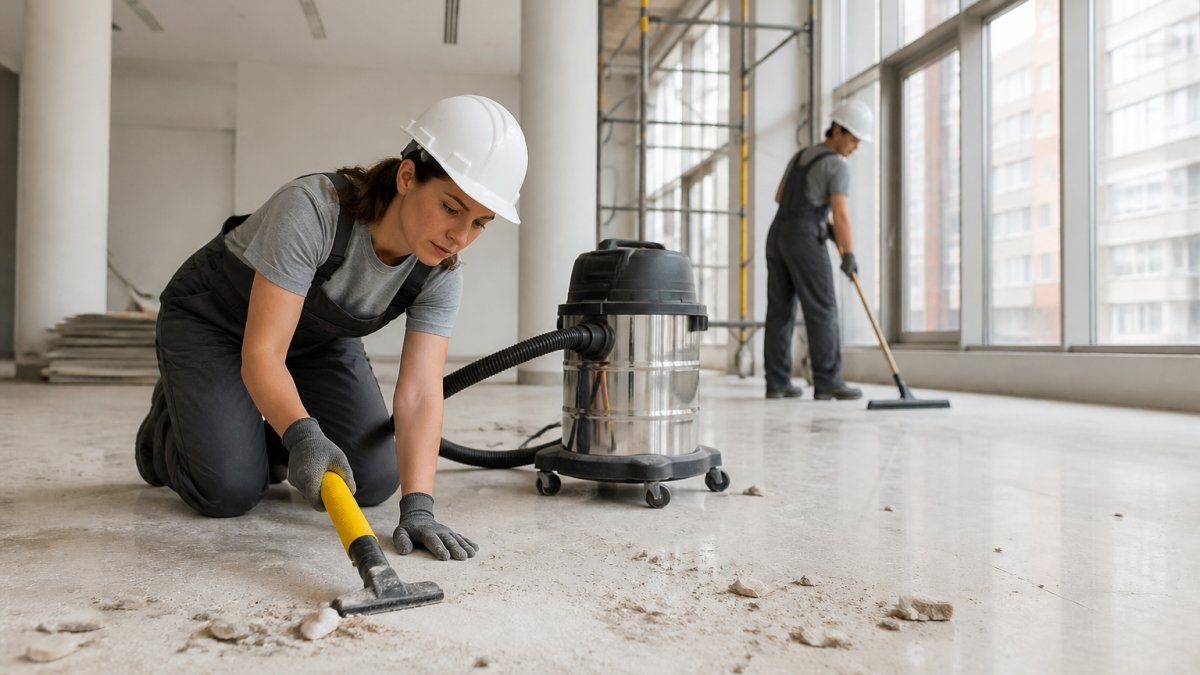
Outsourced providers bring expertise and standardized processes: commercial-grade equipment, staff trained in specialized techniques like floor stripping and waxing, and systems for consistent quality. For deep cleaning before an inspection or emergency post-construction cleanup, they mobilize faster than an internal team.
The trade-off is less day-to-day control: you rely on service agreements rather than adjusting staff directly.
Cost predictability differs. In-house teams carry variable costs, overtime, replacement workers, equipment repairs, while outsourced services offer fixed monthly fees with clear scope.
Using a Commercial Cleaning RFP Template to Evaluate Providers
Before signing with any janitorial provider, you need to know what you're comparing.
Start with the basics: facility size, square footage by area type (office, warehouse, restrooms, break rooms), and cleaning frequency.
Request references from similar facilities, office experience doesn't guarantee understanding of healthcare or post-construction requirements.
A well-structured RFP separates serious providers from those who haven't thought through their operations.
How to Vet a Janitorial Provider Before Signing
Once you've narrowed your options, dig deeper before committing. The cheapest quote rarely delivers the best value, underbidders often cut corners on staffing, training, or equipment.

Visit their current client sites if possible. A provider confident in its quality won't hesitate to show examples.
Ask about their training program, onboarding and ongoing instruction in specialized techniques. Providers that invest in training deliver better results.
Verify insurance and bonding.
Ask for client references and actually call them.
Janitorial Services Contract Checklist: What to Include
A vague janitorial agreement is the most common reason facility managers end up managing complaints instead of a facility. The contract converts "we want it clean" into enforceable terms. Below is the structure that holds up in practice, organized the way a service-level agreement (SLA) is built.
1. Scope of work, written room by room
Don't write "general cleaning." Write the task, area, and frequency:
Restrooms, daily: disinfect all fixtures, restock paper and soap, empty and reline receptacles, spot-clean mirrors and partitions, mop floors with a quaternary disinfectant.
Office and common areas, daily: vacuum all carpeted traffic lanes, empty waste and recycling, wipe horizontal surfaces not holding equipment, spot-clean glass entry doors.
Break rooms, daily: wipe tables and counters, clean microwave exterior, sweep and damp-mop hard floors.
Attach a floor plan with square footage by area type, the unit every provider prices against, so ambiguity here becomes ambiguity in your invoice.
2. Service-level agreement: measurable performance, not adjectives
An SLA turns quality into something verifiable. Build it around four elements:
Inspection cadence. Specify who inspects, how often, and against what checklist. A common pattern is a joint monthly walk-through with the provider's account manager plus your own weekly spot checks using a scored form.
Key performance indicators (KPIs). Pick a small set you will actually track, for example, restroom inspection pass rate, missed-visit rate, and average time to resolve a logged complaint. Define how each is measured and who records it.
Response times. Distinguish routine requests (for example, next scheduled visit), urgent requests such as a spill or restroom outage (same business day), and emergency requests such as water intrusion or post-incident cleanup (a stated number of hours, 24/7). Put the clock in the contract, not in a verbal promise.
Pro Tip Score your own inspections for the first 60 to 90 days. That baseline tells you whether a problem is the provider's execution or an unrealistic scope, and it gives you documented evidence if you need to invoke a remedy.
3. Pricing, billing, and change control
State the recurring monthly fee, what it includes, and what's billed separately. Specialty work, floor stripping and waxing, carpet extraction, high window washing, post-construction cleanup, should be separate line items so routine invoices never surprise you. Include billing cycle, payment terms, and a cap or formula for annual increases. Require written approval before out-of-scope work; this clause prevents the most common billing dispute.
4. Staffing, coverage, and continuity
Specify whether the same crew services your facility, how call-outs are covered, and the maximum time before a replacement arrives. Ask about supervisor site visits. Coverage language protects you the day before an inspection, precisely when an in-house team with no backup fails.
5. Compliance, security, and risk management
This is where serious providers separate from casual ones:
Worker classification. Confirm the provider treats its cleaners as its own employees or properly classified contractors, and that it carries the corresponding payroll and workers' compensation obligations. Misclassification risk should not migrate to your facility.
Background checks and access control. Ask what screening is performed, how keys, fobs, and alarm codes are issued and recovered, and whether the provider maintains a key-control log. For after-hours access, request a named roster of assigned staff.
Chemical handling and safety. Request Safety Data Sheets for products used in your facility, confirm dilution and storage practices, and ask about OSHA-aligned training and incident reporting.
Insurance verification. Require certificates of insurance for general liability, workers' compensation, and, where applicable, commercial auto, and confirm your organization is named as an additional insured. Verify limits and renewal dates rather than accepting a certificate once at signing.
6. Term, termination, and transition
Set the initial term, renewal mechanism, and exit notice period, 30 days is a common baseline, longer for cause-free termination on large accounts. Include a transition clause covering return of keys and access devices, delivery of inspection records, and final reconciliation of services. A clean exit is part of a good contract, not an afterthought.
Key Takeaway A janitorial contract earns its keep through three things: a room-by-room scope, an SLA with named KPIs and remedies, and verified insurance and compliance. Providers who resist putting those in writing are telling you how the relationship will go.
The Hybrid Janitorial Staffing Model: Best of Both Worlds
The hybrid model also solves coverage: when internal staff are sick or on vacation, the contracted service fills the gap instead of leaving your facility uncleaned.
Cost-wise, hybrid splits the difference: fewer internal employees than a fully in-house operation, without premium rates for every service.
The challenge is coordination: clear communication between internal staff and the external provider about who's responsible for what. Without clear boundaries, work gets duplicated or missed.
Choosing the Right Solution for Your Facility
Most facility managers don't struggle to list the alternatives, they struggle to compare them fairly. In-house, outsourced, staffing-agency, subcontractor, and hybrid models all look affordable until priced on the same basis. The framework below does that, then maps each model to the facility profiles where it wins.
Step 1: Build a total cost of ownership comparison
Total cost of ownership (TCO) captures every cost an in-house team creates, not just wages. Use the same categories for every option:
Cost category | In-house team | Contracted provider | Hybrid model |
Direct labor (wages or contract fee) | Hourly wages × hours | Fixed monthly fee | Reduced internal hours + contract fee |
Payroll taxes and benefits | Employer share, PTO, health | Included in fee | Only on retained staff |
Recruiting and onboarding | Job postings, screening, training time | Included in fee | Only on retained staff |
Supervision | Your manager's time | Provider's account manager | Split |
Equipment and supplies | Purchase, storage, maintenance | Included or itemized | Shared |
Insurance | Workers' comp, general liability | Provider carries; verify | Both, on their portions |
Absence and vacation coverage | Overtime or unfilled shifts | Provider's responsibility | Provider backfills |
Turnover cost | Re-hiring and re-training each cycle | Provider absorbs | Provider absorbs for contract scope |
Two mechanics matter most. First, supervision is a real cost, estimate the hours spent scheduling, inspecting, and resolving cleaning issues, valued at a loaded rate. Second, turnover compounds: every replacement triggers recruiting, onboarding, and a quality dip, and those costs recur. The visible wage line often looks cheapest in-house while the fully loaded line narrows sharply or reverses.
Watch Out Do not compare an in-house hourly wage against a provider's monthly fee. Convert both to a cost per square foot per month, or a cost per cleanable square foot per visit, before you decide. That single normalization prevents the most common apples-to-oranges mistake in this evaluation.
Step 2: Map the model to your facility profile
Use these profiles as a starting filter, then refine with your own numbers:
Small office, light soil, standard hours. A single contracted service or even a solo cleaner is usually the simplest fit. The management overhead of an in-house hire rarely pays off at low square footage.
Multi-tenant office or professional building. Contracted service with a defined SLA and a consistent crew tends to win, because tenant satisfaction depends on consistency you cannot personally supervise every night.
Healthcare, dental, or childcare. Infection-control requirements, regulated disinfection protocols, and documentation needs favor a provider with specialized training and verifiable chemical-handling practices. This is a poor candidate for a generalist in-house hire.
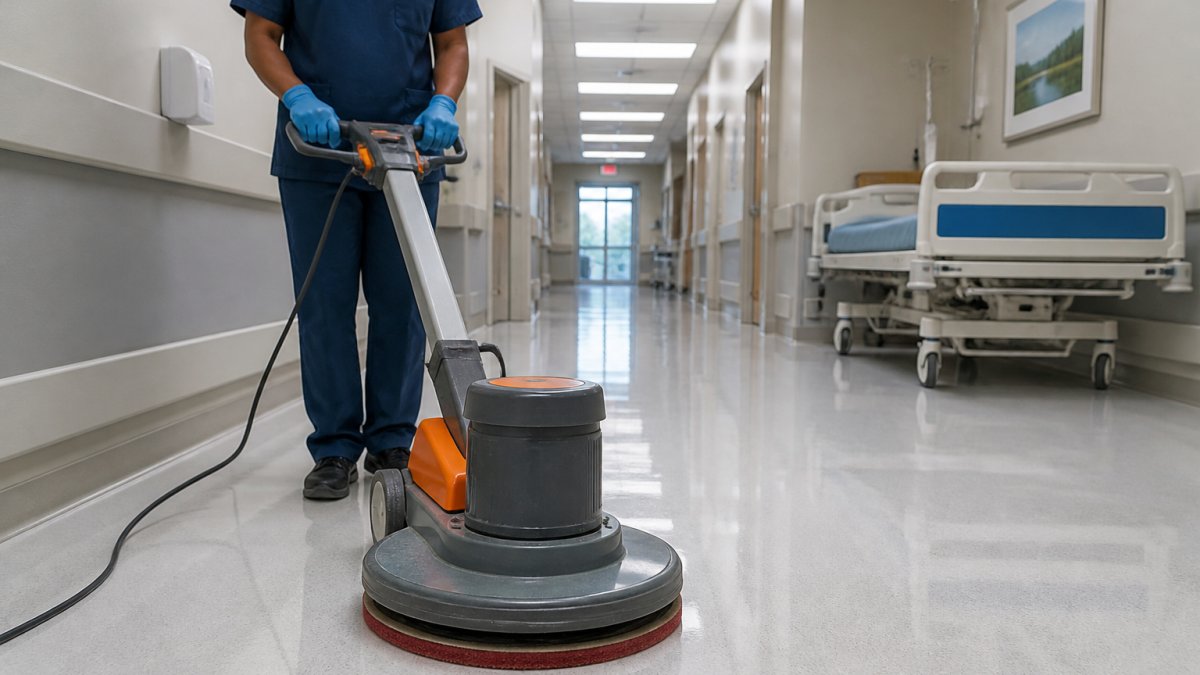
Industrial, warehouse, or manufacturing. Large hard-floor areas, higher soil loads, and safety requirements push toward a provider equipped for auto-scrubbing, burnishing, and floor care, often on a hybrid schedule.
Step 3: Weigh the operating variables
Four variables shift the answer more than size alone:
Operating hours. If your facility runs around the clock, coverage gaps in an in-house team are costly; a provider's bench of staff absorbs them.
Occupancy and traffic. High-traffic restrooms and lobbies need day-porter coverage, which is often a hybrid arrangement: routine cleaning at night, daytime porter for spills and restrooms.
Sanitation and compliance requirements. Regulated environments need documented protocols, training records, and SDS access, capabilities that are hard to build and maintain internally.
Number of locations. Standardization and reporting across sites are easier to buy than to build.
Step 4: Score the options against your priorities
Rank each model on the criteria that drive your decision: total cost per square foot, quality consistency, coverage reliability, control over methods, compliance and risk exposure, and management time. Weight them for your facility, a data center and a retail storefront won't weight them the same. The highest weighted score, not the lowest headline price, wins.
Key Takeaway Choose by profile first, then by TCO. Small, simple, low-traffic spaces favor outsourcing; regulated, high-traffic, or multi-location facilities favor contracted or hybrid models with documented SLAs; specialty work should almost always be outsourced regardless of the rest of your mix.
To run this comparison against your own square footage and operating profile, request a quote and we'll walk through the cost categories and coverage options that fit your facility.
Frequently Asked Questions
What are the main alternatives to in-house janitorial staff?
Businesses can choose from outsourced commercial cleaning companies, independent contractors, hybrid staffing models that combine in-house and contracted cleaning, or specialized service providers for specific needs like post-construction cleanup or floor care. Each option offers different levels of control, cost predictability, and service flexibility. The best choice depends on your facility type, cleaning scope, budget, and staffing capacity.
How do I know if a janitorial provider is properly vetted and reliable?
Check that the provider is fully insured and bonded, verify their MBE certification if required by your contracts, request references from similar facilities, and review their service agreements for clear performance standards and liability coverage. Ask about their employee screening process, training protocols, and how they handle scheduling changes or emergencies. Request a site visit and sample cleaning before committing.
What should a janitorial services contract always include?
A strong janitorial contract should specify cleaning scope and frequency, service-level agreements with measurable performance standards, pricing structure and payment terms, insurance and bonding requirements, emergency response procedures, staffing and supervision details, equipment and supply specifications, liability and damage coverage, cancellation terms, and dispute resolution processes. Include specific protocols for post-construction cleanup or specialized services if applicable.
Can a business use both in-house and outsourced cleaning staff?
Yes. A hybrid janitorial staffing model allows businesses to maintain in-house staff for routine maintenance while outsourcing specialized services like deep cleaning, floor care, or post-construction cleanup. This approach provides cost flexibility, maintains some operational control, and reduces the burden of recruiting and managing a full cleaning team. It works especially well for facilities with variable cleaning needs or multiple buildings across different locations.
Request a Quote

Comments